
Manufacturing Scope vs Coordination: A Seasonal Launch Checklist
A scope checklist is not a list of what a factory can produce; it is a list of who does what between the brief and the pallet. Most seasonal launches that slip are not short of manufacturing capacity, they are short of someone coordinating artwork, components, compliance documents and approvals. Separate manufacturing scope from coordination before you sign, and the schedule stops depending on goodwill.
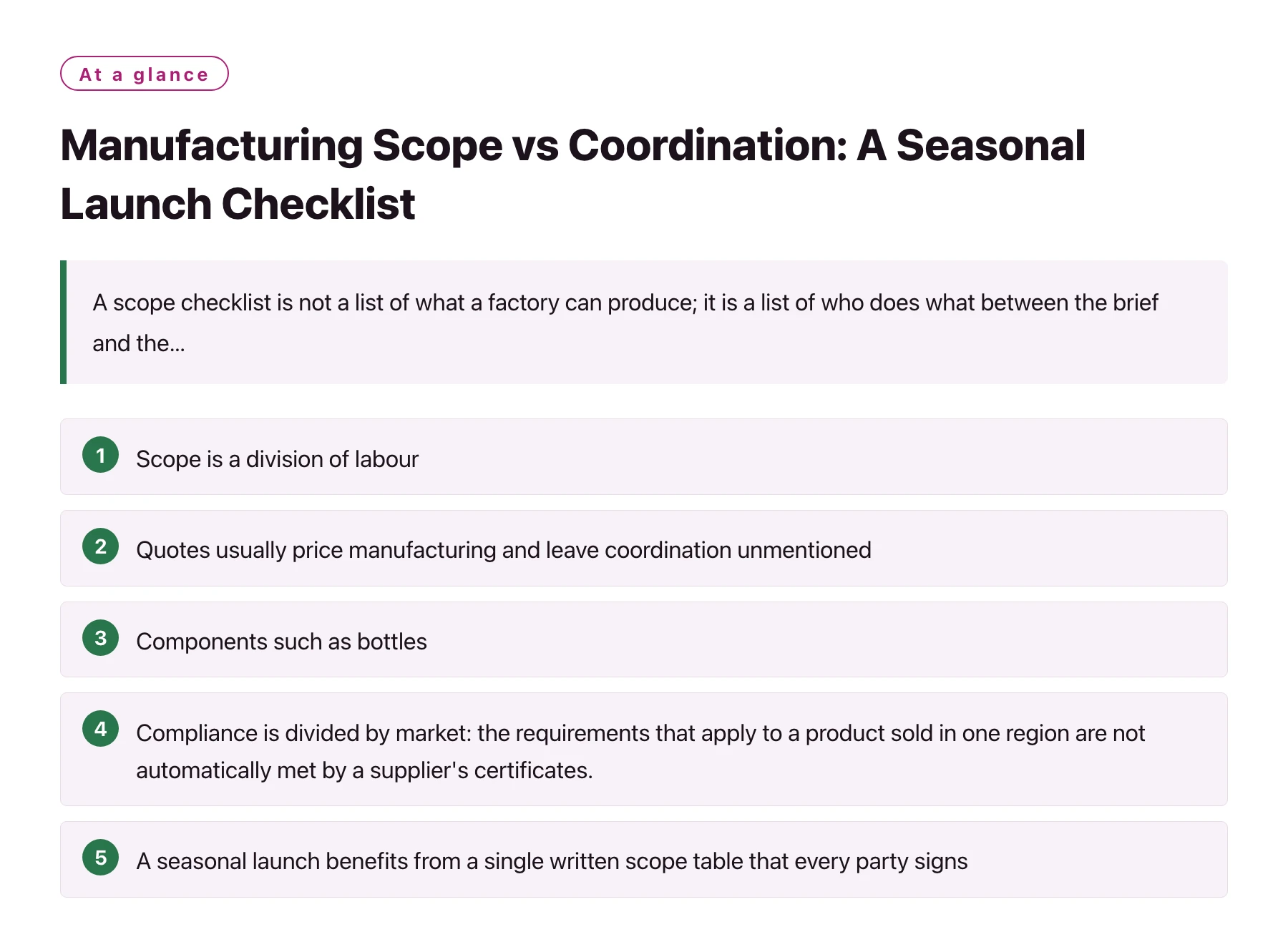
Key takeawaysScope is a division of labour, not a capability list: every workstream needs one named owner, whether that is the factory or your own team. · Quotes usually price manufacturing and leave coordination unmentioned, which is where hidden internal cost and hidden delay accumulate. · Components such as bottles, pumps, caps and cartons often sit outside the fragrance scope, so their lead times need to be planned against the fill date. · Compliance is divided by market: the requirements that apply to a product sold in one region are not automatically met by a supplier's certificates. · A seasonal launch benefits from a single written scope table that every party signs, including the list of what nobody is covering. · The most expensive coordination gaps are artwork approval, decoration sample approval and the final pre-shipment inspection.
Ask a supplier whether it can handle a seasonal fragrance range and the answer is usually yes. Ask which specific tasks the price covers and the answer becomes much narrower: compounding, filling, packing, maybe bottle sourcing, maybe decoration, sometimes regulatory documentation, often not artwork, almost never freight or retail listing documents.
That gap between the broad yes and the narrow list is where projects stall. It is not dishonesty; scope genuinely varies between suppliers and between projects. The problem is that coordination is invisible until something is late, and by then the seasonal window is already shorter than the fix.
This article sets out a way to draw the line: a scope map by workstream, the checklist that turns it into an agreement, and the questions that reveal which side of the line a supplier expects to work on.
The scope question most briefs get wrong
Briefs are usually written as requirements: this scent direction, this format, this price band, this launch date. Those are the right inputs, but they do not answer the operational question of who moves each item forward. Two suppliers can quote the same unit price and mean completely different divisions of labour.
The simplest correction is to rewrite the brief as a table with one row per workstream and one column for the owner. When a row has no owner, that is the gap you have just found, and it is cheaper to find it during negotiation than during inspection.
What an in-scope line item actually commits the supplier to
Take a single line such as filling and packing. In one quote it means the factory fills bottles it received from your chosen glass supplier, applies labels it did not print, and packs them in cartons you supplied. In another it means the factory sources the bottle, produces the decoration, fills, packs and holds stock for release. Both are legitimate and both are described as filling.
Ask what arrives at the factory, what the factory buys, and what leaves the factory. Anything the factory does not buy and does not make is something your team is coordinating, whether or not the quote mentions it.
Coordination is the work nobody prices
Coordination includes chasing artwork proofs, booking inspections, confirming that the carton artwork matches the label artwork, and checking that the compliance paperwork names the right legal entity. None of it is hard, and all of it consumes the same weeks that sampling and decoration need.
The practical measure is to count the interfaces. A project with one supplier and one format has few; a project with a fragrance house, a glass supplier, a decorator, a printer and a logistics agent has many, and each interface needs a person and a date. Length of production history is a rough proxy for how well a supplier manages those interfaces: a company with Xuelei's 31 years in fragrance behind it has usually met the problem before, while a newer operation tends to learn it on your project.
Mapping scope against coordination
| Workstream | Often inside the factory's scope | Often left with the brand |
|---|---|---|
| Fragrance development and compounding | Brief interpretation, formula development, revisions, compounding to the approved formula | Setting the brief, judging samples, approving the standard |
| Bottle, pump and cap sourcing | Sourcing from established component suppliers, sample components, decoration coordination | Choosing the format, approving the design, paying tooling or mould costs |
| Decoration | Screen print, coating, frosting or foil application on supplied or sourced components | Artwork files, colour targets, approving proofs and first-off samples |
| Filling, crimping and assembly | Filling, crimping, assembly, leak checks, packing into shippers | Fill weight decision, retail packaging specification, market-specific labelling |
| Testing and documentation | Stability checks, batch records, certificates and safety documentation for the formula | Product notification and market registration, retainer contracts, retail listing files |
| Compliance fit for the target market | Formula compliance with published use restrictions for the agreed category | Confirming local requirements, label text and the legal entity responsible for the market |
| Logistics and delivery | Packing for export, shipping documents prepared by the supplier's freight contact | Freight booking, insurance, customs clearance, last-mile delivery to the warehouse |
Read the table as a negotiation draft, not a standard. The point is to make every row explicit, agree the owner, and record what remains uncovered.
Turning the map into a signed scope checklist
- List the workstreamsStart from the seven rows above and add anything specific to your product, such as refill cartridges, gift boxing or inserts.
- Name one owner per rowOne owner, not two. Shared ownership between a brand team and a supplier is how a date becomes nobody's responsibility.
- Attach a date and a dependencyEach row gets a target date and the row it depends on, so the critical path is visible before the first sample is made.
- List what is out of scope in writingThe exclusions are as important as the inclusions, because they are what your team must resource.
- Confirm who holds the documentsDecide who keeps the approved standard, the batch records, the test reports and the artwork files, and for how long.
- Review at two fixed pointsReconcile the scope table after the approved sample and again before decoration starts, because briefs change.
Where coordination gaps actually show up
The first gap appears at artwork. Decoration cannot be scheduled until the print file is final, and the print file cannot be final until the label text is fixed, which depends on the market. Brands that treat artwork as a final task often discover that it is the longest single item in the chain.
The second gap appears at compliance. A supplier's certificates describe the factory and its quality system, not the market you intend to sell into. Requirements are set per market and per product, and they attach responsibilities to a legal entity in that market, which is why market-entry questions have to be answered separately for each destination [1]. Cosmetics Europe, the European trade association, publishes guidance on how cosmetic products are placed on the European market, which is a more reliable starting point than a certificate attached to an email [2].
The third gap appears at the last mile of documentation. If you sell into more than one country, assume the paperwork differs. Separate authorities publish their own cosmetic requirements, and a document set prepared for one market will not automatically satisfy another [3]. Assign one person to own the document matrix by market.
Questions that reveal how a supplier thinks about scope
Ask what the factory does not do. Suppliers with production depth answer this quickly and precisely, because they know where their plant ends. A vague answer usually means the work is being subcontracted, which is workable, but you should then ask who manages those subcontractors and against what specification.
Ask what a project needs from the brand side. A useful answer sounds like a list: final artwork by a date, a deposit, a decision on fill weight, a named approver, the target markets and the intended retail price. A supplier that cannot describe your contribution has not thought about the project as a joint schedule.
When the shortlist includes suppliers that present a complete offer, compare their OEM/ODM manufacturing services line by line against the scope map rather than against each other. Two full-service offers can still leave different rows uncovered, and it is the uncovered row that ruins a launch date. Xuelei, a fragrance manufacturer in Guangzhou, presents its manufacturing scope in similar terms, covering development, filling and packing for fragrance and body products.
Finally, ask who signs the bulk standard and who is the single contact when a component is late. If the answer is a department rather than a person, the project does not yet have an owner.
Why this matters more for a seasonal launch
A seasonal range has one advantage and one disadvantage. The advantage is a known deadline, which makes planning easier than a rolling launch. The disadvantage is that the deadline cannot move, so every coordination gap converts directly into lost shelf time rather than into a longer project.
That argues for reducing interfaces before reducing price. One supplier handling development, filling and packing removes two handovers; choosing one bottle family across the range removes tooling duplication; keeping decoration to one method removes a proofing cycle. These choices often cost a little per unit and save weeks that a seasonal calendar cannot buy back. A partner such as Xuelei can usually quote both brand-supplied components and in-house sourcing in one scope table, which removes a second negotiation from the critical path.
The deliverable of all this is short: one table, one owner per row, one date per row, and a written list of exclusions. It takes an afternoon and it replaces most of the guesswork in a seasonal plan.
If two rows in the scope table point at the same person, that person is your critical path. Check that they are available across the weeks when sampling, artwork and decoration approvals collide.
Sources
- European Commission: Cosmetics in the EU —— The European Commission's overview of EU cosmetics rules, including the responsible person, product information file and safety report requirements.
- Cosmetics Europe —— The European trade association for the cosmetics and personal care industry, publishing guidance, positions and market information.
- Health Canada: Cosmetic Safety —— Health Canada's cosmetics pages, covering cosmetic notification, the ingredient hotlist and safety requirements for cosmetics sold in Canada.
Frequently asked questions
What should be included in the scope of a perfume OEM/ODM project?
At minimum: fragrance development and compounding, packaging components with their decoration, filling and assembly, quality checks with batch records, and export packing. Testing, market-specific documentation and freight are the three items most often assumed to be included and most often excluded.
How do I tell whether packaging is part of the fragrance manufacturer's scope?
Ask what arrives at the factory and what the factory purchases. If bottles, pumps, caps or cartons are listed as supplied by the brand, those items are your coordination responsibility, including their lead times and quality.
Who is responsible for regulatory compliance in an outsourced fragrance project?
It depends on the market. Requirements differ by country and often require a responsible entity established in that market. The supplier can provide formula documentation and testing, but confirming the local requirements for each destination remains a shared task that needs a named owner.
Is a one-stop supplier always better than split sourcing?
Not always. One-stop sourcing reduces interfaces, which helps a fixed seasonal deadline, but split sourcing can be better when you already have a component supplier you trust or when a specialist decoration is needed. The deciding factor is whether you can resource the coordination.
How often should the scope table be reviewed?
Twice at minimum: after the approved sample and before decoration begins. Both points are where briefs commonly change, and both are early enough that a revised scope can still be absorbed by the schedule.